

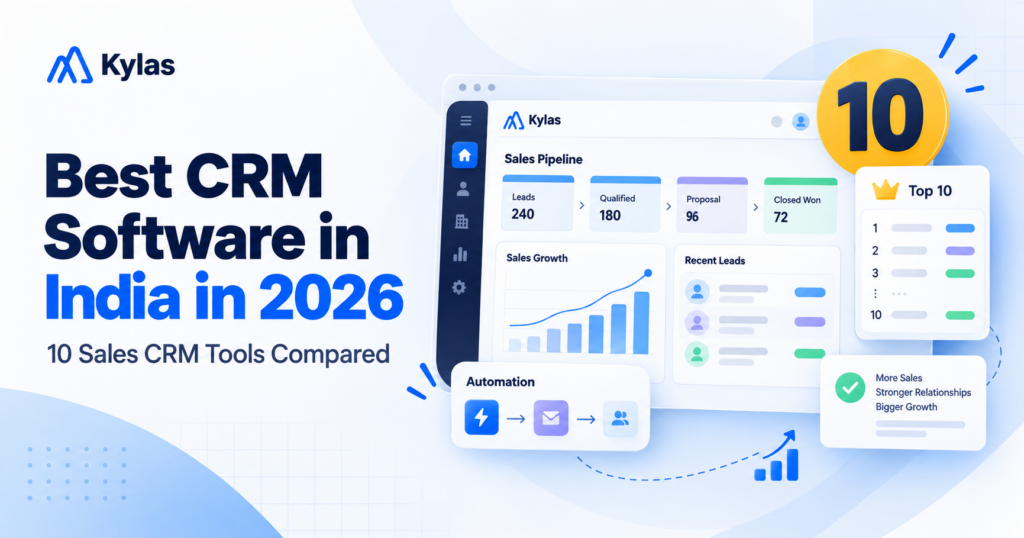
Quick answer: The best CRM for an Indian sales team depends mostly on team size and budget. Zoho Bigin is the cheapest paid start at ₹400 per user per month. Zoho CRM suits teams that want deep customisation from ₹800 per user. Kylas charges a flat ₹12,999 a month for unlimited users, so it becomes the cheaper option once a team reaches about 10 users. LeadSquared fits high-volume and field sales, Salesforce fits enterprises, and HubSpot fits marketing-led teams.
Disclosure: Kylas publishes this guide and is one of the ten CRMs compared. We compared every tool on the same published facts, list Kylas’s limitations alongside everyone else’s, and link to each vendor’s pricing page so you can check our figures.
Best CRM in India by type of team
| If your team is… | Start with | Why |
|---|---|---|
| 1 to 3 people, first CRM | Zoho Bigin | Free for 1 user; paid plans from ₹400 per user per month |
| Small team that wants room to customise | Zoho CRM | Free for up to 3 users; deep customisation from ₹800 per user |
| 10 or more users, or adding non-sales staff | Kylas | ₹12,999 a month flat for unlimited users |
| High lead volume (edtech, BFSI, healthcare) | LeadSquared | Built for fast lead distribution and speed-to-lead |
| Field sales across cities | LeadSquared or Kylas | Mobile apps with field-activity tracking |
| Inside sales with heavy calling and email | Freshsales | Built-in phone and email, AI contact scoring from the entry plan |
| Marketing-led, inbound funnel | HubSpot CRM | Free CRM linked to marketing tools on one platform |
| Large enterprise with complex processes | Salesforce Sales Cloud | Deepest customisation and the largest app marketplace |
| Already running, or planning, an ERP | Odoo CRM | CRM in the same suite as accounting and inventory |
| Visual, cross-team workflows | monday CRM | Board-based work management with a CRM layer |
CRM software prices in India compared (2026)
Entry paid plans, per month, billed annually, before 18% GST. Prices marked ≈ are converted from the vendor’s US dollar list price at ₹96.8 per US$ (rate on 10 October 2026) and rounded to the nearest ₹10; the rupee price shown at checkout may differ slightly.
| CRM | Free plan | Entry paid plan (per user) | Cost for 10 users | Pricing model |
|---|---|---|---|---|
| Zoho Bigin | Yes, 1 user | ₹400 (Express) | ₹4,000 | Per user |
| Odoo CRM | Yes, one app free for unlimited users | ₹725 (Standard, all apps) | ₹7,250 | Per user |
| Zoho CRM | Yes, up to 3 users | ₹800 (Standard) | ₹8,000 | Per user |
| Freshsales | No, 21-day trial | ≈ ₹870 (Growth) | ≈ ₹8,710 | Per user |
| HubSpot CRM | Yes | ≈ ₹870 (Sales Hub Starter) | ≈ ₹8,710 | Per seat |
| monday CRM | No | ≈ ₹1,160 (Basic CRM), minimum 3 seats | ≈ ₹11,610 | Per seat |
| Kylas | Yes, unlimited users, 1,000 records (Embark) | ₹12,999 flat (Elevate), unlimited users | ₹12,999 | Flat fee |
| Pipedrive | No, 14-day trial | ≈ ₹1,350 (Lite) | ≈ ₹13,550 | Per seat |
| Salesforce Sales Cloud | No, free trial | ≈ ₹2,420 (Starter Suite) | ≈ ₹24,200 | Per user |
| LeadSquared | No | ₹2,500 (Sales Pro) | ₹25,000 | Per user, annual billing |
What a CRM costs your team per month
Per-user pricing is cheapest for small teams; a flat fee wins as a team grows. Monthly cost in rupees, before GST, billed annually:
| Team size | Zoho Bigin Express | Zoho CRM Standard | Zoho CRM Professional | LeadSquared Sales Pro | Kylas Elevate |
|---|---|---|---|---|---|
| 5 users | ₹2,000 | ₹4,000 | ₹7,000 | ₹12,500 | ₹12,999 |
| 10 users | ₹4,000 | ₹8,000 | ₹14,000 | ₹25,000 | ₹12,999 |
| 25 users | ₹10,000 | ₹20,000 | ₹35,000 | ₹62,500 | ₹12,999 |
| 50 users | ₹20,000 | ₹40,000 | ₹70,000 | ₹1,25,000 | ₹12,999 |
Kylas Elevate costs less than LeadSquared Sales Pro from 6 users, Zoho CRM Professional from 10 users, Zoho CRM Standard from 17 users and Bigin Express from 33 users. Compare features as well as price: entry plans such as Bigin Express and Zoho CRM Standard have lower limits than their higher tiers.
How we compared these CRMs
We compared each CRM on seven criteria that matter most to Indian sales teams: price and pricing model, free plan, lead capture from Indian sources (IndiaMART, Justdial, WhatsApp), pipeline and automation depth, mobile and field-sales support, reporting, and ease of setup. Prices come from vendor pricing pages and were checked on 15 October 2026. Feature claims come from vendor documentation; we did not run paid trials of every product, so confirm must-have features in a demo.
The tools below are grouped by the team they suit, from the smallest to the largest. The order is not a ranking.
Zoho Bigin: best for first-time CRM users
Best for: teams of 1 to 5 moving off spreadsheets.
Price: free for 1 user and 500 records. Express costs ₹400, Premier ₹720 and Bigin 360 ₹1,080 per user per month, billed annually. See Bigin’s India pricing.
What stands out: Bigin is pipeline-first. Every deal sits on one board and moves by drag and drop, so a small team can start the same day. It connects to other Zoho apps, including Zoho Books for GST invoicing.
Where it falls short: AI features start on the Premier plan, and customisation is limited compared with Zoho CRM. Teams that need approval flows or complex automation usually move to a fuller CRM as they grow.
Verdict: choose it if you need a CRM this week for under ₹500 a user. Skip it if you expect to need approval flows or deep automation within a year.
Zoho CRM: best for customisation on a budget
Best for: small and mid-sized teams that want to shape the CRM around their own process.
Price: free for up to 3 users. Standard costs ₹800, Professional ₹1,400, Enterprise ₹2,400 and Ultimate ₹2,600 per user per month, billed annually. Monthly billing costs more; Standard is ₹1,300.
What stands out: custom modules, fields and layouts on every paid plan, and Blueprint process control from Professional. It sits inside the wider Zoho suite, so finance, support and email can share one login and one customer record.
Where it falls short: Zia AI predictions and the AI assistant start on Enterprise, so the real entry price for AI is ₹2,400 per user. The depth of settings means someone in the team has to own configuration.
Verdict: choose it if someone on your team will own configuration. Skip it if you want AI features without paying Enterprise prices of ₹2,400 a user.
Pipedrive: best for visual deal tracking
Best for: small B2B teams that sell through a clear, stage-by-stage pipeline.
Price: Lite costs about ₹1,350 (US$14) and Growth about ₹3,770 (US$39) per seat per month, billed annually. There is no free plan; a 14-day free trial is available.
What stands out: the activity-based pipeline ties every deal to a next step, which builds a follow-up habit in new reps.
Where it falls short: email sync and automations start on the Growth plan, so most teams pay at least about ₹3,770 per seat. Check support for Indian lead sources such as IndiaMART and Justdial before buying.
Verdict: choose it if your sales process is a clear stage-by-stage pipeline. Skip it if you need automation on a budget, since it starts on the Growth plan.
Freshsales: best for inside sales
Best for: inside-sales teams that work mainly on calls and email.
Price: Growth costs about ₹870 (US$9), Pro about ₹3,770 (US$39) and Enterprise about ₹5,710 (US$59) per user per month, billed annually. A 21-day free trial is available.
What stands out: built-in phone and email, and Freddy AI contact scoring from the entry plan. The interface is clean and quick for new reps to learn.
Where it falls short: multiple pipelines and sync with Freshdesk, Freshworks’ own support tool, need the Pro plan, more than four times the Growth price.
Verdict: choose it if your reps live on calls and email. Skip it if you need multiple pipelines but want to stay on the entry plan.
Monday CRM: best for visual, cross-team workflows
Best for: teams where sales, operations and delivery work on the same boards.
Price: Basic CRM costs about ₹1,160 (US$12), Standard about ₹1,650 (US$17) and Pro about ₹2,710 (US$28) per seat per month, billed annually, with a minimum of 3 seats. There is no free CRM plan.
What stands out: flexible boards and no-code automations that non-technical staff can build themselves.
Where it falls short: Basic CRM has no automations and caps contacts and deals at 1,000, so most sales teams need Standard. Seats are sold in fixed bundles, so a team of 4 pays for 5.
Verdict: choose it if sales already share boards with operations or delivery. Skip it if you need automations on the entry plan or have a team size that falls between seat bundles.
Kylas: best for growing teams that need unlimited users
Best for: Indian SMBs with 10 or more users, or teams that want sales, support and managers on the CRM without paying per seat.
Price: Embark is free for unlimited users with 1,000 records. Elevate costs ₹12,999 per month flat for unlimited users, billed annually. Exceed is priced on request. See Kylas pricing.
What stands out:
- Flat pricing. One fee covers every user, so adding a rep, a manager or a support colleague costs nothing extra. More than 5,000 businesses have signed up for Kylas.
- Indian lead sources built in. IndiaMART leads are captured automatically, and Justdial and website forms feed the same pipeline.
- Inbuilt WhatsApp Business. Reps message prospects from the lead record, and the chat history stays in the CRM. See the WhatsApp feature.
- Field sales. The Android and iOS apps work like the desktop version, and field-sales tracking records visits and distance travelled.
- Onboarding by CRM experts is included, which shortens setup for teams new to CRM.
Where it falls short: for a team of 5, Elevate costs ₹12,999 a month against ₹4,000 for Zoho CRM Standard, so very small teams pay more. Some features, such as Goals and the BI connector, are paid add-ons on Elevate. Kylas has fewer third-party apps than Salesforce or HubSpot.
Verdict: choose it if your team has 10 or more users, or soon will. Skip it if you are a team of 2 or 3 with no plans to grow. See how Kylas compares with Zoho and other CRMs.
LeadSquared: best for high-volume and field sales
Best for: businesses handling thousands of enquiries a month, such as edtech, lending, insurance and healthcare.
Price: Sales Pro costs ₹2,500 and Sales Super ₹5,000 per user per month, billed annually. There is no free plan.
What stands out: fast lead distribution rules, speed-to-lead tracking and a mobile CRM with geo-tracking for field teams. It is built around high-velocity B2C sales.
Where it falls short: no free tier and no monthly billing. Several capabilities, such as portals, are paid add-ons, and setting up distribution rules well takes implementation time.
Verdict: choose it if you handle thousands of enquiries a month. Skip it if you want monthly billing or a free plan.
HubSpot CRM: best for marketing-led teams
Best for: companies whose leads come mainly from content, ads and inbound marketing.
Price: the CRM is free. Sales Hub Starter costs about ₹870 (US$9) and Professional about ₹8,710 (US$90) per seat per month, billed annually.
What stands out: marketing, sales and service share one contact record, so you can see which campaign produced each deal.
Where it falls short: sequences and most automation sit on Professional, ten times the Starter price per seat. Field sales is not its focus.
Verdict: choose it if most of your leads come from marketing. Skip it if you need sequences and automation but cannot budget for Professional.
Odoo CRM: best for teams on an ERP
Best for: businesses that want CRM, quotations, inventory and accounting in one suite.
Price: the One App Free plan gives one app, such as CRM, free for unlimited users. Standard, which includes all apps, costs ₹725 per user per month, billed annually.
What stands out: a won deal flows straight into a quotation and sales order, which suits manufacturers and distributors.
Where it falls short: if you only need a sales CRM, a full ERP suite adds setup work you will not use. Implementation by a partner is usually a separate cost.
Verdict: choose it if you want CRM, quotations and inventory in one system. Skip it if you only need a sales CRM.
Salesforce Sales Cloud: best for enterprises
Best for: large organisations with multiple business units, regions or complex approval chains.
Price: Starter Suite costs about ₹2,420 (US$25) per user per month, billed annually; higher editions cost several times more.
What stands out: the deepest customisation in this list and the largest app marketplace, AppExchange. It can model almost any sales process.
Where it falls short: most teams need a certified admin or implementation partner, which adds to the licence cost.
Verdict: choose it if you have the budget for an admin or implementation partner. Skip it if you need to live for weeks without outside help.
What to check before buying a CRM in India
These five checks catch most of the problems Indian sales teams hit after buying:
- 1. Cost at your team size a year from now. Use the cost table above with your hiring plan, not today’s headcount.
- 2. GST invoice and billing currency. Confirm the vendor issues a GST invoice so you can claim input tax credit, and check whether you are billed in rupees or dollars.
- 3. Indian lead sources. IndiaMART, Justdial, TradeIndia, website forms and WhatsApp should flow into the CRM without manual entry.
- 4. Calling and WhatsApp. Check native support for WhatsApp Business and for your telephony or IVR provider.
- 5. Data protection. Under India’s Digital Personal Data Protection Act, 2023, ask where customer data is stored and how consent is recorded.
Then test each shortlisted CRM with real tasks: create and assign a lead, log a call from a phone, move a deal to the next stage and pull a weekly report. If your reps cannot do these without help, adoption will suffer.
FAQs
1. Which is the best CRM software in India?
The best CRM depends on team size. Zoho Bigin suits teams of 1 to 5, Zoho CRM suits teams that want to customise, Kylas suits teams of 10 or more because of its flat unlimited-user price, LeadSquared suits high lead volumes, and Salesforce suits large enterprises.
2. Which CRM is cheapest in India?
Zoho Bigin Express is the lowest-priced paid plan in this comparison at ₹400 per user per month, billed annually. Free plans are available from Zoho CRM (up to 3 users), Zoho Bigin (1 user), HubSpot, Odoo (one app) and Kylas Embark (unlimited users, 1,000 records).
3. Is there a CRM with unlimited users in India?
Yes. Kylas includes unlimited users on every plan: Embark is free with 1,000 records, and Elevate costs ₹12,999 a month flat. Odoo’s One App Free plan also allows unlimited users, but only for a single app.
4. How much does a CRM cost for a 10-person team in India?
Before GST and billed annually, a 10-person team pays ₹4,000 a month on Zoho Bigin Express, ₹8,000 on Zoho CRM Standard, ₹12,999 on Kylas Elevate, ₹14,000 on Zoho CRM Professional and ₹25,000 on LeadSquared Sales Pro.
5. Do CRM prices in India include GST?
No. Published CRM prices exclude GST, which is charged at 18% on software subscriptions. GST-registered businesses can usually claim it back as input tax credit.
6. Which CRM integrates with IndiaMART?
Kylas captures IndiaMART leads automatically, and Zoho CRM connects to IndiaMART through integrations in its marketplace. For other CRMs, check whether a native integration exists or whether you need a third-party connector.
7. Which CRM is best for field sales in India?
LeadSquared and Kylas both offer mobile apps with field-activity tracking. LeadSquared suits large field teams handling high lead volumes; Kylas suits growing teams that want unlimited users at a flat price.
8. Is Kylas cheaper than Zoho CRM?
It depends on team size. Zoho CRM Standard is cheaper for up to 16 users; from 17 users, Kylas Elevate costs less. Against Zoho CRM Professional, Kylas costs less from 10 users.