Updated On: 14 May, 2026
Over the last decade, B2B teams have been sold a simple idea: If you want to grow faster, add more tools. So companies did exactly that.
They invested in CRMs, email tools, WhatsApp platforms, lead enrichment tools, reporting dashboards, automation platforms, and a dozen other solutions, each promising to solve a specific problem. Individually, each tool worked.
Collectively, they didn’t. Because growth doesn’t break at the tool level. It breaks at the system level. This is the gap that Kylas CRM is designed to solve.
At first glance, most GTM setups look upscale. There’s a CRM in place. Campaigns are running. Leads are coming in. Outreach is happening. But beneath the surface, the system is fractured.
A lead comes in through a campaign, but its context doesn’t fully reach the sales team.A prospect engages on WhatsApp, but that conversation doesn’t influence pipeline decisions.Follow-ups depend on individual discipline rather than structured automation.Reporting becomes an exercise in stitching data rather than understanding it.
What you have is not a system. It’s a set of disconnected activities. And that’s why even high-performing teams often struggle with the following:
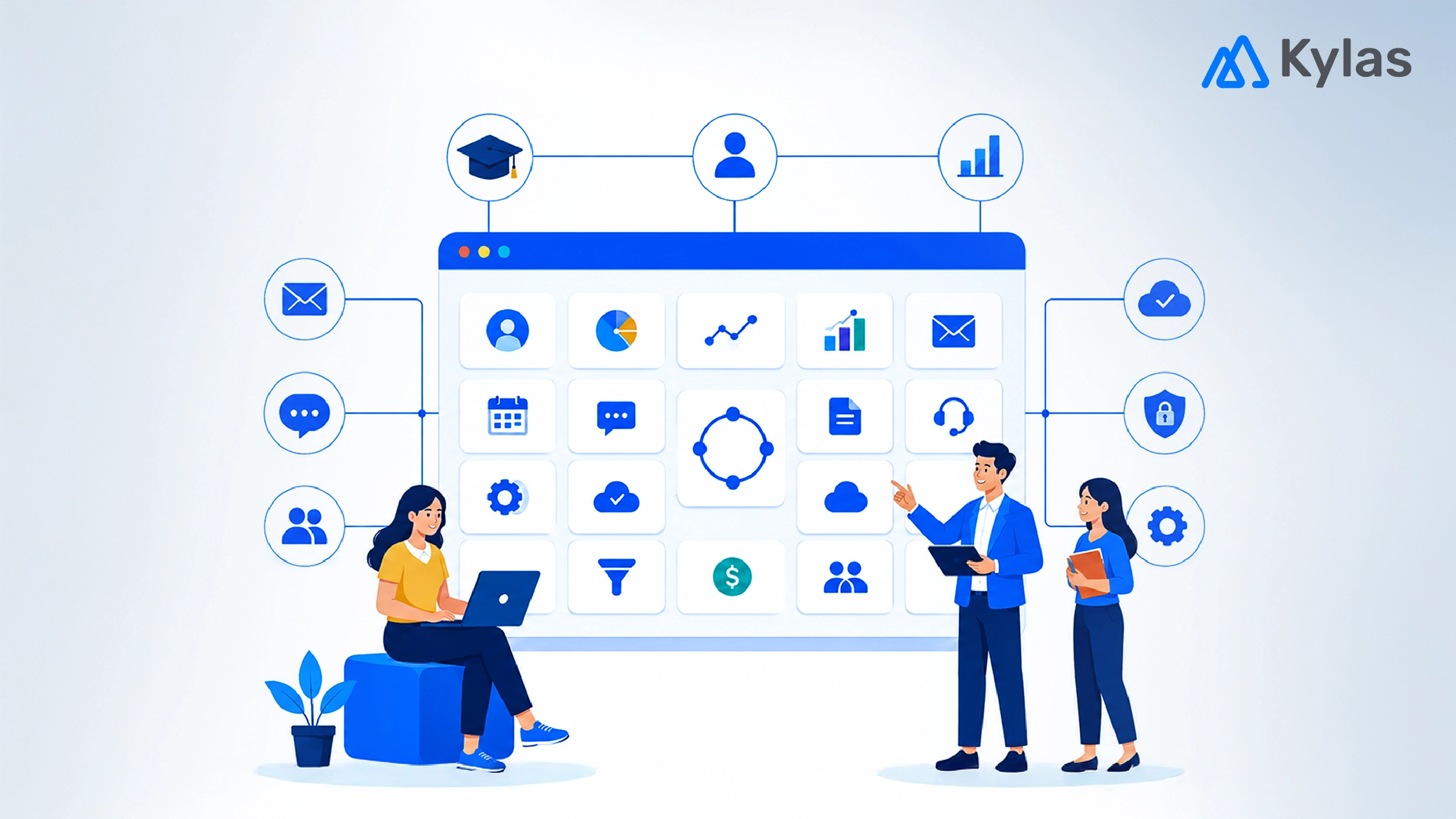
Modern GTM is no longer about executing more activities. It’s about orchestrating them intelligently. This is where the idea of “20 tools in one” needs to be understood correctly.
Kylas is not trying to replace tools for the sake of consolidation. It’s building something fundamentally different:
A unified system where every part of your go-to-market motion, be it marketing, sales, outreach, automation, and intelligence, operates in sync. Instead of asking, “Which tool should handle this?” The system answers, “What should happen next?”
Imagine a typical lead journey in a traditional setup. A prospect visits your website, fills out a form, and enters your CRM. From there, everything slows down. Someone needs to assign the lead. Someone needs to follow up. Someone needs to qualify. Someone needs to remember to re-engage.
Each step depends on someone, and each delay reduces the probability of conversion. Now compare that with a system-driven approach. The moment a lead is generated, the system already understands:
An automated engagement kicks in instantly through the right channel. Initial qualification happens before a human even steps in. By the time a sales rep engages, they are not starting from zero. They are stepping into a conversation that already has context.
Follow-ups don’t depend on memory. They are built into the system. Nothing is left to chance.
What makes Kylas powerful is not the number of features it offers, but the number of dependencies it removes.
Instead of stitching together multiple platforms for communication, automation, tracking, and reporting, everything operates within a single environment.
Your CRM is no longer just a database. It becomes the execution layer. Your communication channels are not external. They are embedded into your workflow.Your automation is not reactive. It is designed into the system from the start.Your reporting is not delayed. It reflects reality in real time.
This is what “20 tools in one” actually means.
Not more capability but less fragmentation.
One of the biggest limitations of traditional systems is that they measure activity, not intent.
You know how many emails were sent.You know how many calls were made.You know how many leads were generated.
But you don’t always know:
Kylas changes this by introducing intelligence into the workflow. Every interaction, every engagement, every signal contributes to a clearer understanding of the customer. So instead of reacting to tasks, your team starts acting on insight.
In most organisations, marketing and sales operate in parallel, not together. Marketing focuses on generating leads. Sales focuses on closing them.
But without a shared system, the handoff is weak. Context is lost. Timing is missed. Opportunities slip through. A unified platform changes that dynamic completely.
Marketing doesn’t just generate leads. It contributes structured data and intent signals.Sales doesn’t just follow up. It operates with clarity and prioritisation. Leadership doesn’t rely on assumptions. It sees the entire funnel as it actually exists.
Alignment is no longer a process. It becomes a natural outcome of the system.
The pace of B2B buying has changed. Buyers expect faster responses, more relevant communication, and a seamless experience across channels.
At the same time, competition has increased, and margins for inefficiency have reduced.In this environment, the advantage doesn’t come from having more tools. It comes from having a system that can:
Want to see how a unified GTM system works in action? Watch this quick video to understand how Kylas brings sales, marketing, automation, and intelligence together in one platform.
<br />
When your GTM is fragmented, you are always reacting. You fix follow-ups. You optimise campaigns. You chase conversions.
But when your system is designed right, you gain something far more valuable: Control! Control over how leads are handled. Control over how decisions are made.Control over how revenue is generated.
The next phase of GTM evolution will not be driven by adding more software. It will be driven by simplifying, consolidating, and systematising.
Because at the end of the day, growth is not a function of how many tools you use. It’s a function of how well they work together. And in most cases, they don’t.
That’s why the future belongs to systems like Kylas, where everything you need is not just available but aligned.
Recommended Articles
Sales CRM
Table of ContentsTurn Every Lead Into GoldAutomate All Your Workflows for Peak EfficiencySay Yes to Data-Driven DecisionsGo Beyond Customer SatisfactionMake…
Published On: October 18, 2023
Table of Contents Traditional Challenges in Dealer & Channel Management Centralising Dealer & Partner Interactions Automating Lead Capture & Distribution…
Published On: April 28, 2025
blog
In India, the end of the financial year (January to March) isn’t just about closing books. It’s when businesses make…
Published On: April 16, 2026