









Everything You Need to Know About SPIN Selling
Posted on January 30, 2026 by Amura Tech
B2B sales don’t necessarily follow a linear, step-by-step path. The transition from initial conversation to demo and closing is rarely smooth. Buyers pause, revisit concerns, involve more stakeholders, and sometimes, change course mid-conversation.
In case of high-ticket sales, buyers arrive at the funnel informed, cautious, yet unsure. They are aware of their options but mindful of the decisions they make, as these impact budgets, teams, and long-term outcomes. Traditional, hard-closing tactics often fail to build the kind of trust that is necessary to convince such buyers.
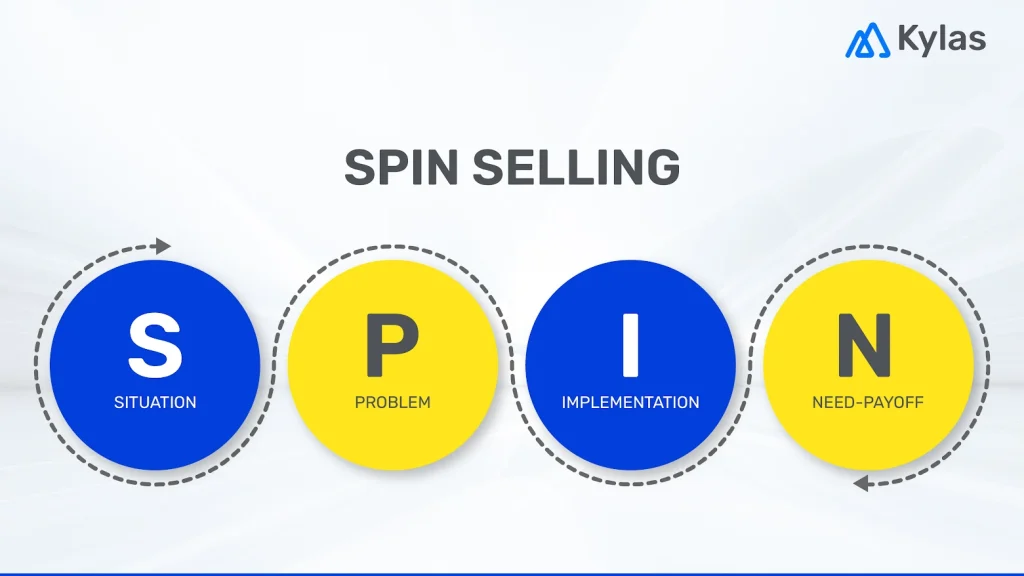
SPIN selling (short for Situation, Problem, Implication and Need-Payoff) is a consultative sales framework designed for these complex buying journeys. Rather than jumping straight into a pitch, it guides sellers to explore a customer’s real challenges and earn trust along the way before offering a solution.
What you’ll learn in this guide
- What is SPIN selling and why does it matter, especially in complex B2B sales?
- The SPIN selling model – built around four main categories of questions to identify customer needs: Situation, Problem, Implication and Need-Payoff.
- How a SPIN selling strategy helps to connect deeply with customers and provide them with solutions they actually need.
- When and where SPIN Selling works best, and how the SPIN selling methodology plays out in real sales conversations.
- SPIN Selling in modern, CRM-driven sales processes.
What is SPIN selling?
SPIN selling was developed by Neil Rackham, based on extensive research into successful B2B sales interactions. Though the concept first appeared in 1988 in Rackham’s bestselling book “SPIN Selling,” it continues to prove itself as one of the most effective methods for high-end selling.
The SPIN sales methodology prioritizes insight-led conversations over persuasion. Instead of pitching a product or service, sales reps ask structured questions to help buyers talk about their problems, recognize the consequences of inaction, and eventually arrive at a solution more confidently and on their own terms.
Four types of questions in the SPIN selling model
The SPIN selling model structures sales conversations around four question types that progressively uncover context, surface problems, explore consequences, and clarify the value of a solution.
Situation questions
Situation questions establish context by exploring the buyer’s existing environment, processes, and tools. They help sales reps gather facts without making assumptions.
For example:
- What tools are currently used to manage sales activities?
- How are leads tracked and followed up on?
- How is performance measured across the team?
Problem questions
Problem questions uncover inefficiencies, pain points, or gaps in the current setup. They encourage buyers to communicate issues they may not have fully acknowledged or prioritized.
For example:
- Are there challenges with follow-ups or visibility?
- Where do delays or errors typically occur?
- What makes it difficult to maintain consistency when following up on leads?
Implication questions
Implication questions connect problems to their broader business consequences. These questions help buyers understand why an issue matters by highlighting its effect on revenue, productivity, or risk.
For example:
- How does this affect forecasting accuracy?
- What happens if the issue continues over time?
- How does this influence leadership decisions?
Need-payoff questions
Need-payoff questions help buyers articulate the value, benefits, and importance of solving the problem. Instead of the seller explaining value, the buyer defines it themselves.
For example:
- What would change if follow-ups were automated?
- How would a more efficient system improve results?
- What impact would better visibility have?
- How would improved forecasting support decision-making?
When and where does SPIN selling work best?
SPIN selling works best in complex, high-impact B2B sales where decisions involve multiple stakeholders, require careful evaluation, and significant investment. It is particularly effective when:
- Sales cycles are long or multi-stage
- Buyers are unsure about the root cause of their challenges or underestimate the consequences of inaction
- Solutions require process or behavioral change
- Decisions affect different teams or departments
Is SPIN selling ideal for all B2B sales?
SPIN selling methodology is not a one-size-fits-all approach. It is most effective in complex B2B sales where buyers may not fully understand their problem or its business impact. In these situations, structured questioning helps surface hidden needs and guide better decisions.
However, the SPIN selling strategy may be less effective in simple, transactional, or low-involvement sales, where buyers already know what they want and speed is the primary driver. In such cases, extensive discovery can slow down the sales process unnecessarily.
To apply SPIN selling effectively, sales teams should adapt the depth of questioning to the deal complexity. The framework works best when used flexibly, focusing on deeper exploration for high-stakes decisions while keeping conversations efficient for lower-value opportunities.
What are the benefits of using the SPIN selling strategy?
The SPIN selling strategy offers several advantages, particularly in complex sales environments:
- Stronger buyer trust: Buyers feel understood rather than sold to
- Deeper discovery: Sales conversations move beyond surface issues to core business problems
- Higher deal quality: Solutions are aligned to business impact or critical buyer needs, making it more compelling
How does SPIN selling fit into modern sales processes?
SPIN selling has stood the test of time and earned its place in the playbooks of today’s top businesses because it supports how complex B2B decisions are actually made – through careful evaluation, shared understanding, and clearly articulated value. However, asking the right questions is only part of the process.
For sales teams to benefit fully from SPIN, the insights uncovered during discovery must be recorded and carried forward across deal stages. Sales CRM systems like Kylas Sales CRM support this by providing a central place to capture buyer context, track implications, and align follow-ups across teams.
In this way, SPIN selling remains not just a questioning framework, but a practical approach that fits naturally into modern, CRM-driven sales processes.