

Acquiring customers is becoming more expensive for SaaS companies, making customer acquisition cost (CAC) a critical growth metric. 2025 SaaS Benchmarks Report found that the most efficient SaaS teams recover CAC in 13 months or less, while payback periods can stretch much further as companies scale.
Rising advertising costs, longer buying journeys, fragmented customer data, and increasing competition can quickly push CAC upward. Simply increasing marketing spend does not always solve the problem.
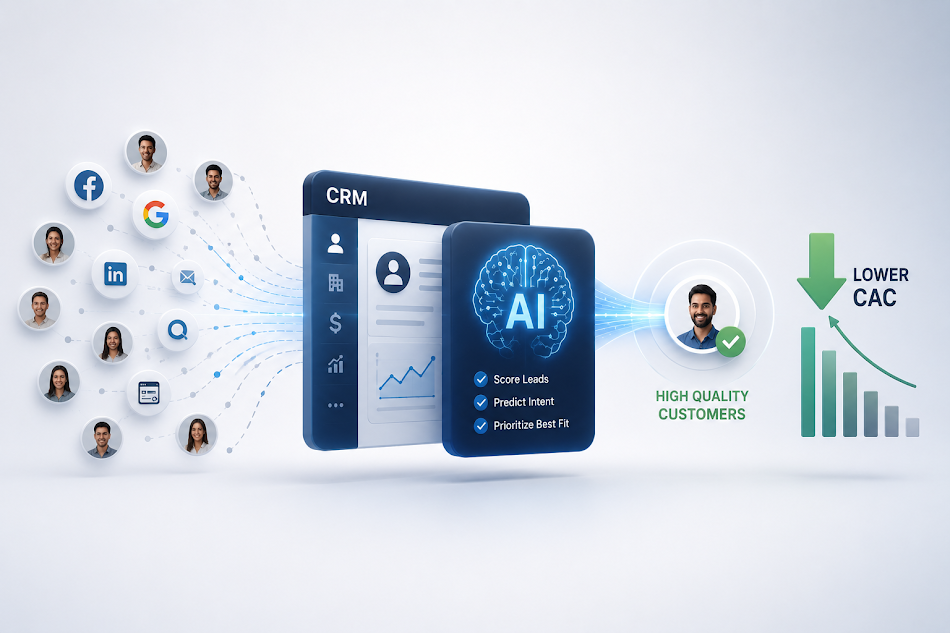
For SaaS businesses, the better approach is to make every acquisition effort more efficient. CRM and AI can help teams identify higher-quality prospects, automate repetitive sales activities, prioritise leads, and improve conversion rates. This makes it possible to lower customer acquisition cost without continuously increasing marketing budgets.
What Drives Customer Acquisition Cost?
Customer acquisition cost represents the total cost of acquiring a new customer, including advertising, content marketing, sales salaries, software, events, and agency fees. A simple way to calculate CAC is:
CAC = Total Sales and Marketing Costs ÷ Number of New Customers Acquired
SaaS companies can reduce CAC by cutting unnecessary acquisition costs or increasing the number of customers generated from existing resources. CRM and AI can support both by improving how teams identify, manage, nurture, and convert prospects.
Common Reasons for High CAC in SaaS
- Low-quality leads: Marketing campaigns may generate large volumes of leads with little likelihood of converting.
- Marketing Teams: invest in standalone email engines and ad tools to drive top-of-funnel leads.
- Manual sales processes: Data entry, follow-up reminders, lead assignment, and reporting consume valuable sales capacity.
- Long sales cycles: More interactions before purchase increase the cost of acquiring each customer.
- Poor conversion rates: High marketing spend with few resulting customers pushes CAC upward.
- Disconnected data: Separate marketing and sales systems can cause valuable customer information to be lost between stages.
Understanding these problems is the first step in figuring out how to reduce customer acquisition cost.
How CRM Helps Reduce Customer Acquisition Cost
A CRM gives SaaS teams a centralised view of leads, conversations, activities, and opportunities, making saas customer acquisition more structured and measurable.
Improve Lead Management
CRM systems capture leads from different sources and organise them within a single pipeline. Sales teams can see where prospects originated, their interactions, and their position in the buying journey.
This helps representatives focus on higher-potential opportunities instead of manually sorting through disconnected lead lists.
Automate Repetitive Sales Tasks
A sales CRM can automate follow-up reminders, lead assignments, task creation, notifications, and pipeline updates. This reduces administrative work and gives sales teams more time for customer conversations.
Shorten the Sales Cycle
Automated notifications and follow-ups help representatives respond faster to high-intent prospects and keep opportunities moving through the pipeline.
Improve Conversion Visibility
CRM reporting shows which lead sources, campaigns, and sales activities generate customers. Teams can then identify inefficient channels and allocate resources more effectively.
For businesses evaluating how to reduce CAC, improving sales efficiency can be as important as reducing marketing expenditure.
The Role of AI in Customer Acquisition
AI adds another layer of efficiency by analysing customer information and automating decisions at scale. It can help SaaS companies:
- Prioritise leads: Identify prospects showing stronger buying signals.
- Automate communication: Assist with personalised messages and follow-ups.
- Predict conversion potential: Analyse historical patterns to identify promising prospects.
- Surface insights: Highlight important customer activities that sales representatives may miss.
- Reduce administrative work: Automate repetitive tasks and support data-driven recommendations.
When combined with CRM data, AI helps teams make acquisition decisions using actual customer and sales signals rather than assumptions.
Strategies to Lower CAC and Improve Growth
If you’re looking for how to reduce cost per acquisition, focus on improving the entire acquisition process rather than a single channel.
Focus on High-Quality Leads
Analyse customer data to identify channels, segments, and characteristics associated with successful conversions. Marketing teams can then focus campaigns on prospects with stronger potential.
Automate Follow-Ups
Create automated workflows for different buying stages. Timely responses and nurturing can improve conversion without requiring additional sales headcount.
Align Sales and Marketing
A shared CRM provides visibility into lead sources, engagement, pipeline movement, and conversion outcomes, making it easier to identify where leads are being lost.
Measure Revenue, Not Just Leads
Generating more leads does not necessarily mean achieving low cost customer acquisition. Track qualified opportunities, conversion rates, CAC, sales cycle length, and revenue by channel.
Use AI to Prioritise Resources
AI can help sales teams focus on prospects and activities most likely to contribute to revenue, improving productivity without proportional increases in headcount.
Build a SaaS Customer Acquisition Engine
Reducing the customer acquisition cost SaaS companies face is ultimately about improving efficiency across the customer journey. Better lead qualification, faster follow-ups, cleaner data, automated workflows, and stronger sales visibility can help businesses generate more value from existing acquisition spend.
A CRM such as Kylas CRM can centralise customer data, automate sales workflows, and provide greater pipeline visibility. Combined with AI-driven insights, it can help SaaS businesses build a more focused acquisition process and pursue sustainable growth without relying solely on higher marketing spend.
FAQs
1. What is customer acquisition cost (CAC) in SaaS?
Customer acquisition cost is the total sales and marketing cost required to acquire a new customer. It includes expenses such as advertising, sales salaries, software, content, and events. Kylas CRM can help teams track sales activities and improve acquisition efficiency.
2. How can SaaS companies reduce customer acquisition cost?
SaaS companies can reduce CAC by improving lead quality, automating follow-ups, shortening sales cycles, and focusing resources on high-converting channels. Kylas CRM can support these efforts through centralised customer data and sales workflow automation.
3. How does CRM help reduce CAC?
A CRM centralises lead and customer information, automates repetitive sales tasks, and provides pipeline visibility. This helps sales teams prioritise promising opportunities and improve conversion efficiency. Kylas CRM helps businesses manage these activities from a centralised sales platform.
4. Can AI help SaaS companies reduce CAC?
Yes. AI can help prioritise leads, identify buying signals, automate communication, predict conversion potential, and reduce administrative work. When combined with CRM data, these capabilities can help sales teams focus their resources more effectively. Kylas CRM can complement this approach with structured customer and pipeline data.
5. How does CRM help improve sales pipeline management?
CRM like Kylas helps businesses manage multiple pipelines, automate follow-ups, track pipeline performance, forecast revenue, and identify bottlenecks from one dashboard. This enables sales teams to spend less time on administration and more time closing deals.