


Every new tool promises to solve a problem. One improves prospecting, another automates outreach, a third enriches contact data, while another tracks performance. Individually, they appear valuable. Together, they often create a fragmented sales tech stack that is more expensive and harder to manage than expected.
Today’s sales and marketing organisations use more than 10 software tools on average, yet the growing complexity rarely translates into better execution. Research also suggests that fragmented GTM operations can cost a 50-person revenue team between $800,000 and $1.4 million annually through operational inefficiencies, lost productivity, and disconnected workflows.
Rather than accelerating growth, many revenue operations tools create more manual work and disconnected processes. The challenge is no longer adding software but building a GTM ecosystem that helps teams move faster with fewer tools.
What Is a GTM Stack?
A go-to-market stack is the collection of technology used to support every stage of the revenue journey, from generating leads and managing customer relationships to sales engagement, reporting, automation, and analytics.
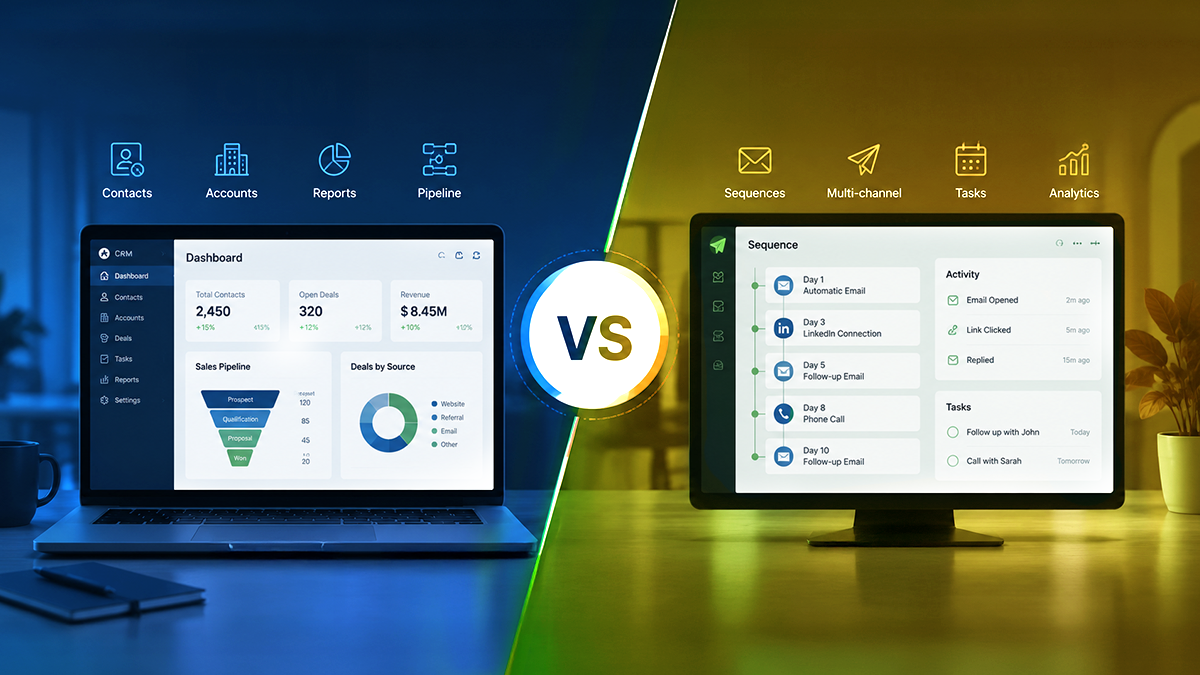
A modern GTM stack typically consists of six core technology categories, including CRM, sales engagement, prospecting, data enrichment, reporting, and workflow automation. While businesses previously relied on numerous specialised applications, many are now consolidating around fewer, better-integrated platforms that simplify execution without compromising capability.
Why Companies Use Many Sales Tools
Most organisations never intend to create a fragmented technology ecosystem. Tool sprawl usually happens gradually.
A sales manager adopts one of the latest sales enablement tools to improve prospecting. Marketing introduces a separate automation platform for campaigns. RevOps invests in reporting software, while customer success adds another engagement solution. Each purchase solves an immediate challenge, but over time the stack becomes increasingly disconnected.
Soon, multiple tools perform the same tasks, from lead enrichment and email sequencing to meeting scheduling and reporting. Teams begin switching between applications to complete a single workflow, while duplicate customer records and inconsistent data become everyday challenges.
Although individual sales automation tools deliver value, they rarely work as one connected system. Instead of enabling seamless sales workflow automation, they often create additional processes for teams to manage.
How Do Fragmented GTM Tools Impact Sales Productivity?
The highest hidden costs of fragmented tools go far beyond software subscriptions. As businesses add more CRM integration tools, prospecting platforms, and automation software, operational complexity increases while sales productivity declines. Integration management alone can consume 20–30% of RevOps bandwidth, leaving less time for strategic revenue initiatives. Sales representatives are equally affected, spending only 28% of their working week actively selling, with the rest lost to administrative tasks, manual data entry, and switching between disconnected systems. When customer data, communication history, and pipeline updates are spread across multiple platforms, follow-ups become slower, duplicate records become common, and reporting becomes less reliable.
Reps spend more time verifying data than engaging prospects, while broken integrations reduce reporting accuracy. For organisations investing in GTM stack sales productivity tools, this fragmented approach directly impacts response speed and conversion opportunities. A unified CRM reduces manual work, eliminates data silos, accelerates follow-ups, and gives sales teams more time to sell.
Benefits of a Unified CRM
A unified CRM centralises customer data, sales activities, and automation into one platform, helping businesses eliminate silos and streamline their GTM operations. Instead of juggling multiple tools, teams gain a single source of truth that improves visibility, collaboration, and execution.
Key benefits include:
- Centralised customer data and communication history
- Improved collaboration across sales and marketing teams
- Faster decision-making with real-time pipeline visibility
- Reduced manual data entry and duplicate work
- Better sales workflow automation and follow-up consistency
- Complete customer context through integrated buyer intent and engagement data
- Simplified CRM integration tools and fewer operational bottlenecks
By consolidating workflows into one platform, businesses spend less time managing tools and more time building relationships, accelerating sales cycles, and driving predictable revenue growth.
How to Build a Simplified GTM Ecosystem
Reducing technology complexity does not necessarily mean replacing every tool. It means identifying where your stack creates duplication instead of value. A practical approach to sales tools consolidation starts with a simple audit:
- Review every tool currently used across sales, marketing, and RevOps.
- Identify overlapping features and duplicate workflows.
- Evaluate which CRM integration tools create unnecessary maintenance or manual effort.
- Consolidate around a smaller number of platforms that support multiple business functions.
- Make CRM the primary workflow layer for customer data, pipeline management, reporting, and automation.
An effective GTM ecosystem should cover the core technology categories without requiring multiple applications for the same job. By reducing complexity, businesses improve adoption, simplify operations, and create a more scalable foundation for future growth.
How Kylas Simplifies Your GTM Stack
As businesses grow, sales teams often find themselves managing separate tools for lead tracking, follow-ups, reporting, workflow automation, and customer communication. Kylas brings these core capabilities together into a single, all-in-one sales platform, reducing the need to stitch together multiple point solutions.
Built specifically for growing businesses, Kylas combines CRM, sales automation tools, lead management, workflow automation, reporting, and communication features within one platform. Teams can manage lead tracking, follow-ups, pipelines, and customer interactions from one unified workspace.
By centralising customer information and streamlining day-to-day workflows, Kylas helps businesses reduce operational complexity while giving revenue operations tools and sales teams greater visibility into every stage of the customer journey. The result is a connected GTM workflow that supports faster execution, better collaboration, and more predictable revenue growth.
Conclusion
The highest cost of an overloaded sales tech stack is not the software itself but the operational friction it creates. Every disconnected tool adds another layer of complexity, slowing response times, increasing administrative work, and reducing visibility across the revenue cycle.
When companies grow, success depends on simplifying rather than expanding the go-to-market stack. Consolidating on a unified CRM helps eliminate unnecessary complexity, enabling teams to focus on customers rather than managing tools. If you’re looking to simplify your GTM operations without compromising functionality, Kylas offers a functional starting point for building a more connected and efficient sales ecosystem.
FAQs
What does a GTM stack refer to?
A GTM (go-to-market) stack is the collection of tools businesses use for CRM, prospecting, sales engagement, automation, reporting, and customer communication to support the entire revenue process.
Why do companies use excessive sales tools?
Most businesses add tools to solve individual challenges over time. This often leads to overlapping functionality, disconnected workflows, duplicate data, and higher operational costs.
How does a unified CRM improve sales productivity?
A unified CRM centralises customer data, automates routine tasks, and reduces context switching, helping sales teams respond faster, collaborate better, and spend more time selling.
Why should businesses consolidate their sales tech stack?
Sales tools consolidation reduces software costs, integration complexity, and manual work while improving data accuracy, reporting, and overall GTM efficiency.
How does CRM help simplify a GTM stack?
CRM-like Kylas brings lead management, workflow automation, reporting, and communication into one platform, helping businesses reduce tool sprawl, streamline sales workflows, and manage customer relationships from a single workspace.