

A sales representative starts the day with a prospect list on one platform, customer history in another and follow-up tasks somewhere else. By the time they piece together what happened and what to do next, valuable selling time is already gone.
This is not a minor productivity problem. Sales representatives can spend up to 10 hours a week on non-selling work, including CRM upkeep and other administrative tasks. Research from Gartner also found that AI can save sellers an average of 4.8 hours per week, although organisations often fail to redirect that time towards higher-value sales activities.
This is where the debate around CRM vs sales engagement platform begins. The question that most businesses face is: do you really need both a CRM and a sales engagement platform?
The answer depends on how your sales process works, how much outreach your team handles and whether your current CRM can support the actions needed to move prospects through the funnel.
Evolution of CRM and Sales Engagement Platforms
The traditional distinction was straightforward. Modern sales, however, is far more connected. A prospect’s email response can change the next sales action. A missed call can trigger a follow-up. A WhatsApp conversation can alter the status of an opportunity. A sales representative’s activity can influence pipeline forecasts.
In other words, data and action are no longer separate parts of the sales process.
This is why modern CRMs increasingly include communication tools, workflow automation, sales sequences, follow-up management and AI-powered assistance. The question is no longer simply whether a CRM and a sales engagement platform offer different features.
More importantly, do you need two separate systems to manage one connected sales process?
What Does a CRM Do?
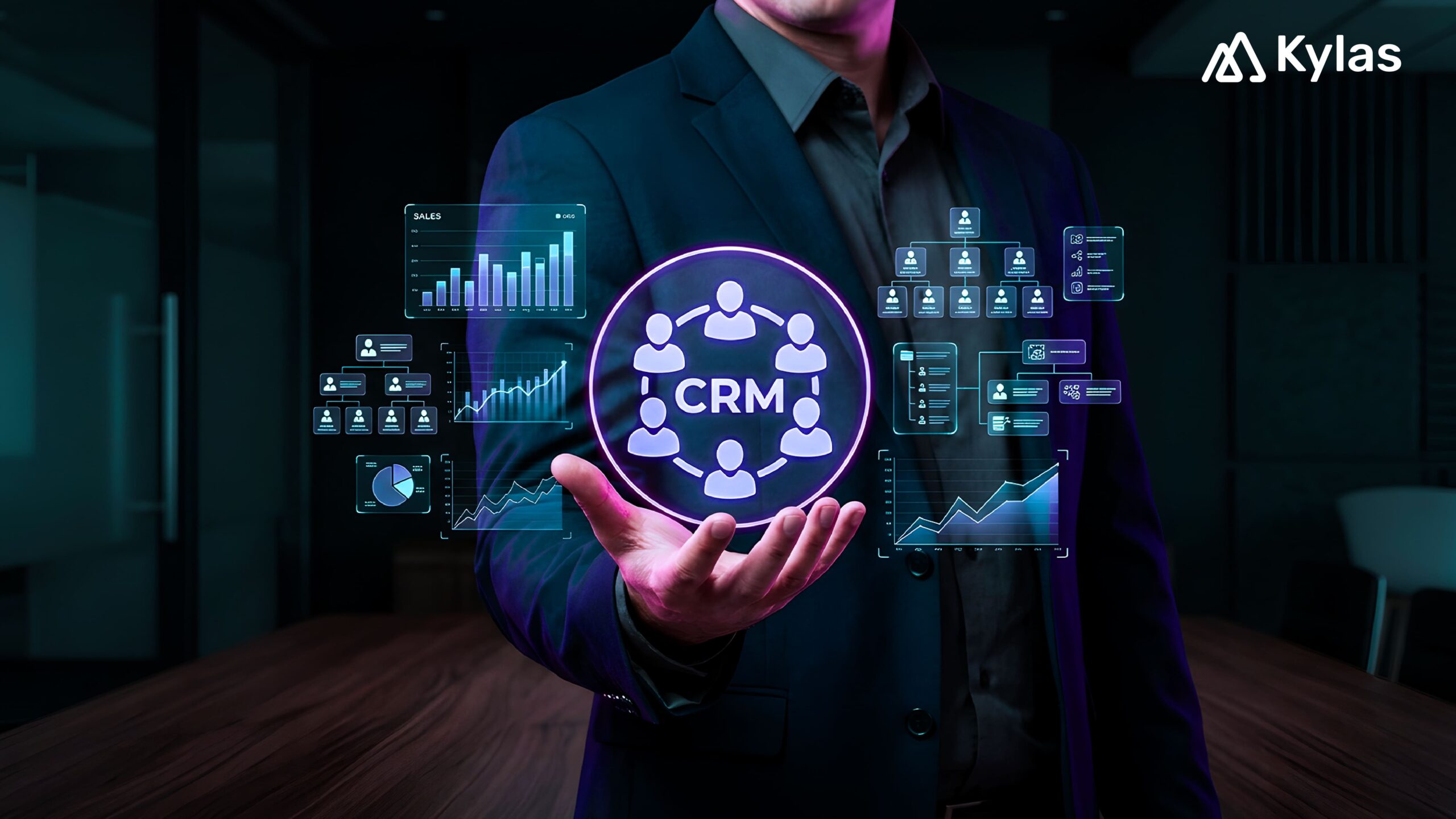
At its core, a CRM helps businesses capture leads from different sources, organise contact and company information, track opportunities, manage pipelines, record customer interactions, assign leads and tasks, automate repetitive workflows, monitor sales performance and forecast revenue.
The real value of a CRM lies in context. A salesperson should be able to see more than a name and a phone number. They should understand where the prospect came from, what conversations have already taken place, what the prospect needs, what action is due next and how the opportunity is progressing.
Managers need that same visibility at a broader level. They need to know which opportunities are moving forward, which sales representatives need support and where leads are getting stuck.
That is what makes a CRM more than a contact database. A well-structured CRM becomes the central system that connects sales activity with business outcomes.
What Does a Sales Engagement Platform Do?
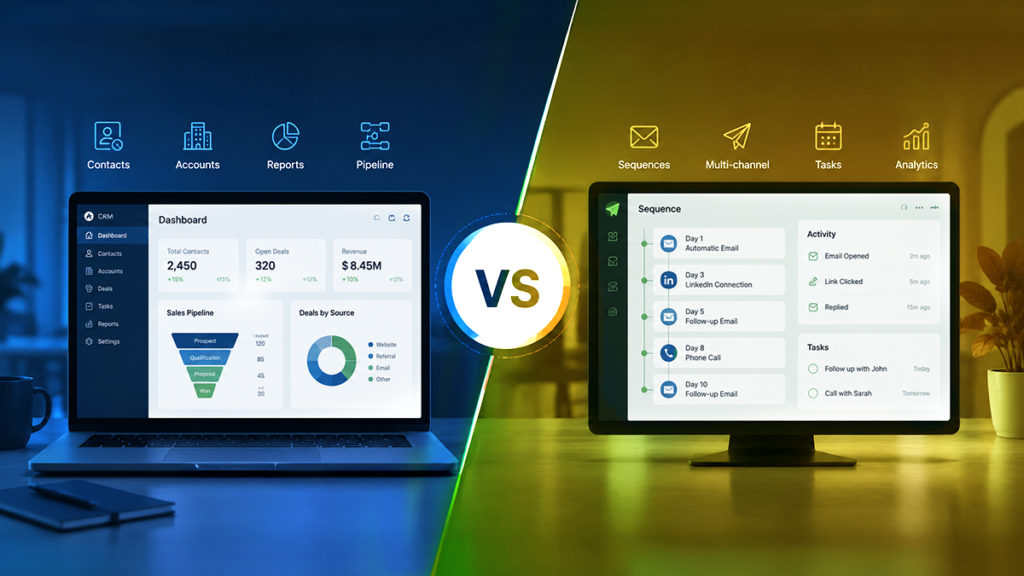
A sales engagement platform supports activities such as creating outreach sequences, scheduling emails and calls, automating follow-ups, managing cadences, tracking engagement, coordinating multiple touchpoints and prioritising prospects based on activity.
A sales engagement platform creates a defined cadence. For example, a prospect might receive an initial email on day one, a follow-up call on day three, a second email on day five, another call or message on day eight and a final follow-up on day twelve.
The goal is not to send every prospect the same generic message; it’s to make sure that promising opportunities do not disappear simply because of a forgotten follow-up.
That is why sales engagement platforms are especially valuable for teams with high-volume outbound sales processes.
CRM vs Sales Engagement Platform: The Core Difference
The simplest way to understand the difference is to look at the primary job each platform performs.
| CRM | Sales Engagement Platform |
| Manages customer and prospect data | Manages prospect outreach |
| Tracks accounts and opportunities | Executes sales sequences |
| Provides pipeline visibility | Organises follow-ups |
| Supports forecasting and reporting | Tracks engagement activity |
| Manages the broader sales lifecycle | Focuses on sales execution |
In practice, however, these functions increasingly overlap. That overlap is exactly why businesses need to look beyond feature lists when comparing sales platforms.
Can a CRM Replace Sales Engagement Software?
A CRM can replace a dedicated sales engagement platform when it provides the engagement capabilities the sales team actually needs.
For example, a sales team may be able to capture a new lead, automatically assign it to the right salesperson, qualify the lead, initiate email or WhatsApp communication, create follow-up tasks, automate future touchpoints, track engagement, convert the prospect into a deal and manage the opportunity through the sales pipeline.
When those activities happen in one connected system, the CRM becomes both a system of record and a system of action.
Final Verdict
There is no universal answer. A sales CRM provides the foundation for managing relationships, customer data, sales pipelines and revenue opportunities. A sales engagement platform specialises in helping sales teams execute structured prospect outreach.
If your sales representatives are already switching between multiple tools to manage one prospect, adding another platform may create more friction. If your team has a strong CRM but lacks the specialised capabilities needed for large-scale outbound engagement, a sales engagement platform may add meaningful value.
Ultimately, the best sales technology stack is the one that helps your team move from first interaction to closed deal with fewer gaps. The end goal is to make every sales action count without additional sales software.
For teams looking for a more connected approach, Kylas brings CRM and sales execution capabilities together in one platform. Sales teams can manage leads, contacts, accounts, opportunities and pipelines while also using communication tools, automated workflows, follow-up management, sales sequences, reporting and AI-powered capabilities.
This allows businesses to move from lead capture and qualification to outreach, follow-up, opportunity management and revenue tracking without constantly moving between disconnected systems.
The result is a more connected sales process where representatives have the context to know what to do next and the tools to act on it.
Explore Kylas to see how a connected CRM can help your sales team manage relationships, automate repetitive work and move opportunities through the pipeline more efficiently.
FAQs
1. What is the difference between a CRM and a sales engagement platform?
A CRM manages customer and prospect information, relationships, opportunities and sales pipelines. A sales engagement platform focuses on structured prospect outreach through activities such as emails, calls, sequences and follow-ups.
2. Can a CRM replace a sales engagement platform?
Yes, if the CRM provides the communication, automation, sequencing and engagement capabilities the sales team needs. Businesses with highly specialised outbound workflows may still benefit from dedicated sales engagement software.
3. Is sales engagement software necessary for every sales team?
No. The need depends on the size, volume and complexity of the sales process. For many teams, a CRM with built-in engagement capabilities is enough.
4. Should you use a CRM and a sales engagement platform together?
You may benefit from using both if your sales team needs specialised high-volume prospecting capabilities alongside a broader CRM. The two platforms should be well integrated to avoid fragmented data and duplicate work.
5. What should you consider when comparing sales platforms?
Consider the complete sales workflow, including lead management, communication, follow-ups, automation, pipeline visibility, reporting, integrations and ease of use. The best platform is the one that reduces friction across the sales process.