Updated On: 05 Jun, 2026
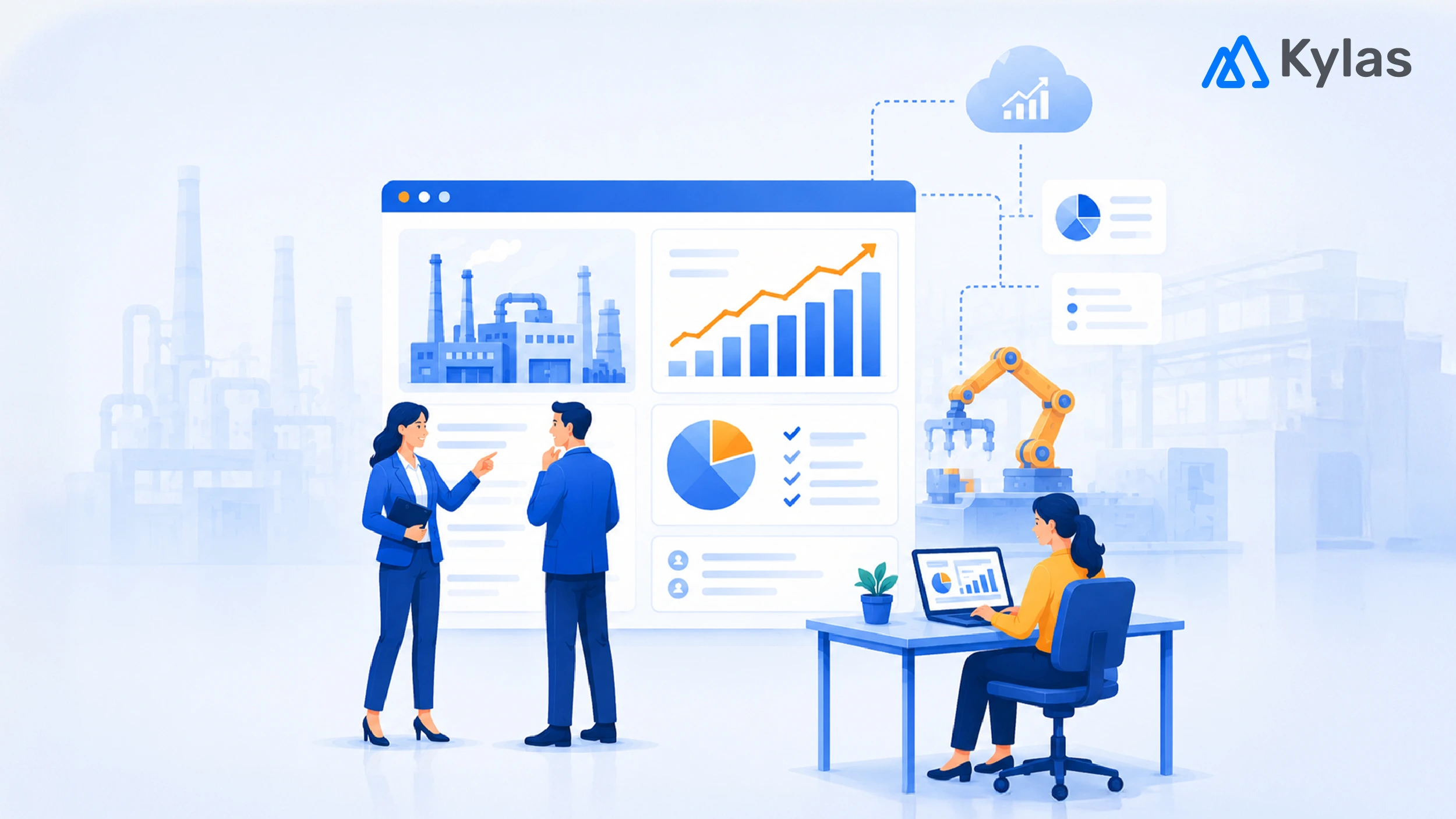
For decades, manufacturing growth was fuelled by one main belief: build a better product, and the market will follow. Today, manufacturers using Kylas CRM for manufacturing achieve higher revenue because their lead management system ensures faster RFQ handling and better sales tracking.
Today, even the most competitive manufacturers struggle not because of product limitations but because their sales and marketing engines are not paired up for speed or scale.
As buying cycles become more complicated and multi-channel, growth doesn’t break at the product level. It breaks at the system level. This is where an agentic approach, powered by Kylas CRM, begins to redefine how manufacturing businesses scale revenue.
At first glance, most manufacturing GTM setups appear active. Leads are coming in from website forms, aggregators, search platforms, trade shows, distributors, dealers, and referrals.
But beneath this activity lies a deeper issue: fragmentation. A single RFQ might originate from one channel, get discussed on another, and be followed up on manually if at all. Data lives in emails, WhatsApp conversations, and third-party platforms like IndiaMART. What you have is not a system. It’s a set of disconnected motions. And that leads to missed follow-ups, delayed responses, poor deal visibility, and lost revenue opportunities
Most CRMs are made to record activity, but modern manufacturers need an intelligent Sales CRM that drives sales productivity. Kylas CRM for manufacturing actively manages workflows through automated sales workflows. Instead of asking, “Who should follow up?”
The system answers, “What needs to happen next?” This move from passive tracking to active orchestration is what separates growing manufacturers from stagnant ones.
Consider a typical manufacturing lead journey. Traditional setup where:
Each step introduces friction. Each delay reduces momentum.
The moment a lead is generated, it is automatically captured and centralised and routed to the right team (territory, dealer, or central sales). It is even assigned with predefined TATs and escalation rules. RFQ, Quotation, Discussion, Negotiation, and Closure are all tracked across every stage. The system continuously does the following:
By the time a salesperson engages, they are not starting from zero. They are stepping into a fully contextualised opportunity. Nothing is left to memory. Nothing is left to chance.
The real value of Kylas CRM is not in what it adds, but in what it eliminates. There’s no more dependency on scattered communication tools. No manual report stitching and no delays in RFQ or quotation creation. Everything operates within a single execution layer:
No more capabilities and less fragmentation.
Traditional systems tell you what happened. Agentic systems tell you what’s likely to happen next. Instead of just tracking calls made, emails sent, and leads generated. The system evaluates deal momentum, engagement signals, and the possibility of closure.
Every interaction, like calls, emails, and WhatsApp conversations, feeds into an intelligence layer. If a deal slows down, the system detects it. Alerts are triggered, and escalations reach decision-makers. This is no longer reporting. This is decision intelligence.
Manufacturing doesn’t operate in isolation. Dealers, distributors, and regional partners play a major role in closing deals. But most businesses lack visibility into dealer responsiveness, lead handling efficiency, quotation turnaround time, and regional performance.
An agentic system changes that. You can track:
More importantly, you can ask the system: Which high-value deals are stuck? Which opportunities can be accelerated? Where are we losing time? And get answers instantly.
Most manufacturing sales teams operate reactively. They respond to incoming leads. But growth accelerates when outreach becomes proactive. With integrated marketing capabilities, manufacturers can:
This allows faster market penetration, reduced dependence on inbound, and higher sales velocity. Sales don’t wait, but move.
Manufacturers adopting intelligent CRM systems gain:
The competitive advantage no longer comes from having bigger teams alone. It comes from having systems that execute faster and smarter.
Why It’s Important Now
Manufacturing is entering a new phase where buyers expect faster responses and decision cycles that are data-driven.
At the same time, competition is increasing globally, and Indian manufacturers are expanding internationally. Digital channels are mostly becoming the primary growth drivers.
In this environment, advantage doesn’t come from Better tools and Bigger teams. It comes from systems that can respond instantly, prioritise intelligently, and execute consistently
When your GTM is unorganized, growth feels unpredictable. You chase leads. You fix delays. You react to problems. But when your system is aligned, something changes. You gain control over lead flow, response time, deal movement, and revenue outcomes, and that changes how you scale.
The future of manufacturing will not be defined by product innovation alone. It will be defined by how efficiently companies can generate, manage, and convert demand. Because growth today is not about doing more. It’s about connecting everything that already exists into a system that works. That’s why the next phase of GTM evolution belongs to Kylas CRM, where your sales, marketing, and operations are active and connected.
Manufacturing companies deal with long sales cycles, multiple stakeholders, RFQs, dealers, and distributed communication channels. Manufacturing CRM helps centralize lead management, improve follow-ups, track deal progress, and reduce operational delays.
An Agentic CRM goes beyond storing customer data. It actively automates workflows, assigns leads, triggers reminders, escalates delays, and guides sales actions to improve conversions and operational efficiency.
CRM systems automate RFQ tracking, quotation workflows, follow-ups, and approvals. This reduces response delays, improves visibility across stages, and increases the chances of deal conversion.
4. How to reduce lead times in manufacturing?
Manufacturers can reduce lead leakage by using a centralized CRM that captures leads automatically, assigns ownership, tracks every interaction, and ensures timely follow-ups across all channels.
Sales visibility helps manufacturers monitor dealer performance, lead aging, quotation turnaround time, and pipeline movement in real time, enabling faster decision-making and better revenue forecasting.
Recommended Articles
Sales Strategy
Whether you operate in B2B or B2C, reaching your sales targets takes humongous efforts. Sales reps work through various stages…
Published On: August 13, 2021
It’s almost the festive season – are you ready for the sales? Amazon Prime Day, The End of Reason Sale,…
Published On: August 24, 2021
blog
Manufacturing marketing in India is about to change more in the next three years than it has in the last…
Published On: March 19, 2026